
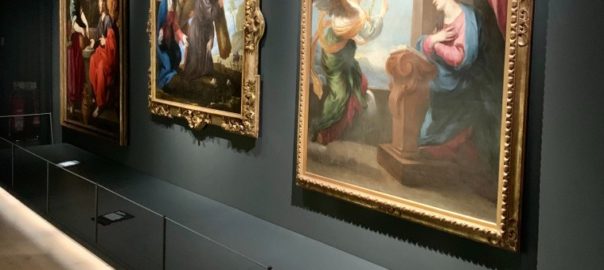
The Spanish Gallery Art Exhibition in the United Kingdom tells a story of Golden Age Spanish art during the 16th and 17th centuries, exploring how its artists expressed the tension between man’s yearning for eternity and the self-evident transience of life. Francisco de Zurbarán’s collection of masterpieces, Jacob and His Twelve Sons, have hung in Auckland Castle Long Dining Room for more than 250 years. These intriguing paintings have hung in the Long Dining Room at Auckland Castle for over 250 years and are a must-see for art lovers.
Visitors can enjoy the exhibitions or participate in the museum’s wide range of art-related programs, activities and special events. General admission is always free for all, thanks to the Rosenthal Family Foundation. Museum members receive additional benefits.
The museum is supported by the generosity of individuals and businesses that give annually to ArtsWave. The Ohio Arts Council helped fund the museum with state tax dollars to encourage economic growth, educational excellence and cultural enrichment for all Ohioans. The museum gratefully acknowledges operating support from the City of Cincinnati, as well as our museum members.
Through the power of art, we contribute to a more vibrant Cincinnati by inspiring its people and connecting our communities.
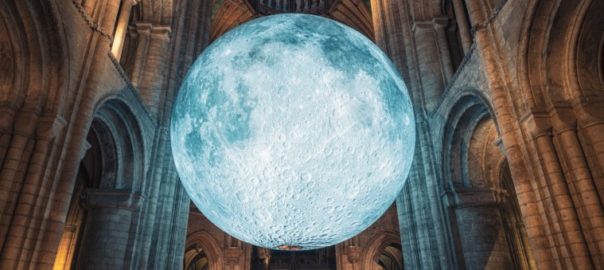
Museum of the Moon is a touring artwork by UK artist Luke Jerram.
Measuring seven metres in diameter, the moon features 120dpi detailed NASA imagery of the lunar surface. At an approximate scale of 1:500,000, each centimetre of the internally lit spherical sculpture represents 5km of the moon’s surface*.
Over its lifetime, the Museum of the Moon will be presented in a number of different ways both indoors and outdoors, so altering the experience and interpretation of the artwork. As it travels from place to place, it gathers new musical compositions and an ongoing collection of personal responses, stories and mythologies, as well as highlighting the latest moon science.
The installation is a fusion of lunar imagery, moonlight and surround sound composition created by BAFTA and Ivor Novello award winning composer Dan Jones. Each venue also programmes their own series lunar inspired events beneath the moon.
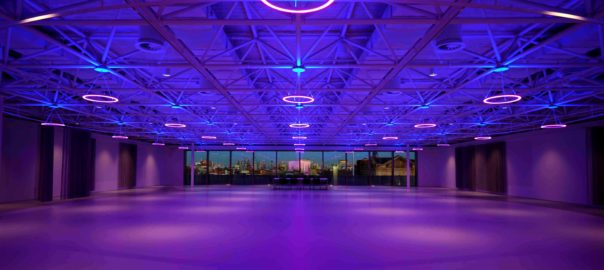
Illuminate at The Science Museum: A serious sit-down or a fabulous festival, the event space does it all
Home to world-class collections of scientific, technological and medical advancements, Illuminate at The Science Museum in London can now host private events for those drawn by unique features and panoramic views of the City. Covering two floors, spanning nearly 1000 square meters, with a mix of light scene requirements, Xicato Controls with wireless Bluetooth technology allow for customized light scene configurations for a professional atmosphere or a dance party disco.
“We wanted to develop an award-winning event space that drew people in because of its uniqueness, while offering a comfortable and productive environment. Xicato’s Controls system made it all possible—all via Bluetooth and controlled with an iOS app.” Julie O’Reilly from
Sutton Vane Associates.
Occasions of Any Kind
The flexibility and ease of programing of the Xicato wireless Controls was a key requirement to create the custom lighting atmospheres that could change from day to day. The museum could be holding a conference for the Royal Society of Biology one day and a UNICEF Aid dinner with a vastly different lighting needs the very next. The main level includes custom designed luminaires with RGBW pendants in the mix, all of which use Bluetooth Mesh controls. The controls allow rapid change between classic functional lighting for work to colorful, flashy displays for parties and dancing. The lighting design included a total of 530 lighting nodes throughout both floors that were assigned to one of twenty scenes, ten on the fourth floor and ten on the fifth floor, via Xicato Control Panel software. To add mystique, the ambiance included features such as a decorative DMX grid controlled by an LPC (Lighting Playback Controller) system, and a “Planet Light” in the stairwell to help blend the floors in a high tech yet elegant fashion.
The DMX grid on the lower floor is directed to display various scenes via Xicato Low Voltage Contact Switch (XSW) that sends wireless Bluetooth commands to a Xicato Gateway (XIG) which communicates with the LPC. The integration between the LPC system and Xicato’s Bluetooth Mesh Controls is seamless. Xicato’s open architecture allows for unparalleled flexibly enabling a customized application like no other in the market.
Customized to scientific precision, all lights are individually controlled via an iOS app commissioned by Sutton Vane Associates that can be overridden thru manual switches, with the ability to recall pre-defined scenes and groups. Groups were chosen based on location and functional requirements: fourth floor is one scene, fifth floor another, while bathrooms and hallways have their own scenes. The Xicato Bluetooth Gateway receives commands from the App and communicates via Bluetooth to the individual lighting nodes. For guaranteed robustness, Xicato Relay Nodes were placed throughout the building to extend the Bluetooth network resulting in ubiquitous network reach.
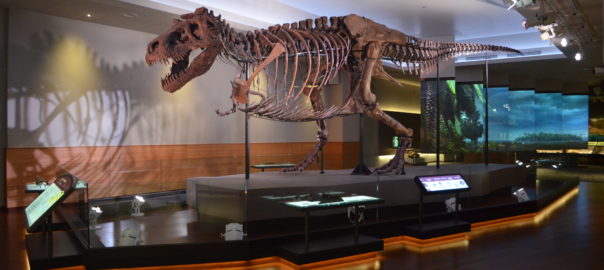
Xicato’s world class lighting solutions with open API + ETC’s software enable leading light designers to deliver a life-like experience, worthy of the world’s most magnificent fossil.
Sue, the world’s longest Dinosaur lives in Chicago within a collection that dates as far back as 1893 in the Chicago’s Field Museum overlooking the Lake Michigan shoreline. Even within the impressive collection of over 40 million artifacts, the museum’s most prized possession is no doubt the very unique member of the family Sue, the world’s most complete Tyrannosaurus specimen. The fossils alone reach forty feet making up the most expensive collection in the world at nearly $8.7 million. Discovered in 1990, Sue’s first debut at the Chicago Field Museum was in 2000 and remains today a rare look into the dinosaur world of 67 million years ago.
The First AV Execution of its Kind
A display of Sue’s magnitude needs to be extremely flexible, of highest quality and lifelike without use of damaging sunlight on the delicate artifacts. For a theatrical presentation, the exhibit designers at the Field Museum deployed ETC color-changing fixtures incorporating Xicato’s class leading complete solutions including Bluetooth controls hardware, software and light sources renowned for their quality. Using the Xicato’s open API platform, ETC created a software module within their Mosaic Show Controller to send show cues to the Xicato Intelligent Modules light source (XIM), triggering preset scenes for the exhibit lighting. This flexibility allowed a seamless integration between the wired DMX controls and Bluetooth Mesh wireless Xicato Controls. Both companies believe in open control platforms and architectures allowing designers the flexibility to customize and deploy the appropriate control solutions for the application.
“The use of theatrical fixtures controls the focus onto different parts of the display, making it appear more life-like. We created drama through fixtures that excite the audience, encourage them to use their imaginations,” Thatcher Waller, Lighting Designer, Lightswitch Chicago.
Xicato is at the forefront of intelligent and connected lighting controls that allows light designers to bring their art to life with unparalleled light quality and consistency with an unmatched 7 years of guarantee. Light designers consistently select Xicato when only the best quality and flexibility is called for.
“With Xicato’s open API, we strive to foster interoperability between control systems and lighting to bring environments to life, all while minimizing the involvement of manual operation,” Sam Miri, Senior VP Sales & Business Development, Xicato.
The existing installation was one-dimensional, and Jeroen Pijl, responsible for the exhibition lighting at The Museon, felt the 2700K color temperature used throughout had a “soporific” effect on visitors. The new lighting design was carried out by Joost de Beij, whose brief included emphasizing the architecture to a full extent, making navigation easier around the various exhibits, and maximizing a feeling of well-being among visitors. Nearly 400 track spots are mounted in display cabinets and at ceiling level, with ceiling and floor mounted wall-washing around all columns. A suspended band of colour-changing lighting snakes its way around the whole exhibition, providing its own brand of connectivity.
The XIM gen4 modules contain a wireless Bluetooth Low Energy (BLE) board that can communicate with mobile devices such as smartphones and tablets, or with PCs using the Xicato Control Panel software. The Control Panel allows The Museon to create multiple, secure networks containing a virtually unlimited number of lights, sensors, or switches, providing simple commissioning of the various lights and lighting groups, scene creation (e.g. for cleaning or service modes), and outputs settings for each fixture and exhibit during normal operating hours.
Two electrical contractors installed and adjusted the luminaires followed by a half day to program the lighting levels, groups, and scenes. It was simple and efficient taking advantage of the XIM modules and Xicato’s lighting configuration tool, Control Panel Software.
Serving over 1.5 million visitors per year, the Van Gogh Museum in Amsterdam is host to 200 paintings, 400 drawings and 700 letters by Vincent van Gogh, the largest such collection in the world, as well as traveling exhibitions of other artists and collections. Van Gogh’s Sunflowers, The Potato Eaters, several of his Wheatfield and Self-Portraits, and many other iconic works are on permanent display in a beautiful, multi-story building owned by the Dutch government.
In January, 2017, the Van Gogh Institute began a phased process of converting all of the lighting in both the Van Gogh Museum and the Mesdag
Collection in The Hague – approximately 1300 light points – to Xicato Intelligent Modules with Bluetooth control (XIM Gen4). The work is being done entirely after hours, without disrupting normal operations, and without moving or replacing either the artwork or the existing lighting infrastructure. No new track. No wires. No holes in the wall. No dust. The results are significant savings in energy and maintenance, but their primary motivation is Conservation.
When the San Francisco Museum of Modern Art (SFMOMA) reopened, after being closed for three years for expansion, new lighting using Xicato’s XTM modules was just one of the dramatic improvements to the space and exhibits. The expansion more than doubles the museum’s gallery spaces and provides almost six times as much public space as the previous building. Designed by the architecture firm Snøhetta, SFMOMA seamlessly integrates a 10-story expansion with the original Mario Botta–designed building to create 460,000 square feet.
As the largest modern and contemporary art museum in North America, SFMOMA is also the largest museum in North America to be illuminated with LED lighting. Arup was the Lighting Designer for SFMOMA and was involved with all the elements which create the sensory environment of the building and galleries — lighting, acoustics, audiovisual technologies, and building envelope design. Arup specified recessed track fixtures from Lighting Services Inc. with Xicato XTM Artist modules as the light source.
SFMOMA received LEED Gold certification for the building’s efficiency in its mechanical, lighting, water, and other systems.
The Smithsonian’s National Museum of African American History and Culture in Washington DC is a nine-story building with five levels above ground and four more below. The 400,000-square-foot building includes exhibition space, a theater and café, staff offices and an education center.
The building offers a number of prismatic angles and viewpoints known as “lenses,” or opportunities for visitors to view the White House and the Washington Monument, as well as other locations around the National Mall from unique framed perspectives—”a view of America through the lens of the African American Experience.”